Archive for 'Nominees'
Invictus
February 2nd, 2010. Published under Nominees. No Comments.
Out of the night that covers me,
Black as the pit from pole to pole,
I thank whatever gods may be
For my unconquerable soul.
In the fell clutch of circumstance
I have not winced nor cried aloud.
Under the bludgeonings of chance
My head is bloody, but unbowed.
Beyond this place of wrath and tears
Looms but the Horror of the shade,
And yet the menace of the years
Finds and shall find me unafraid.
It matters not how strait the gate,
How charged with punishments the scroll,
I am the master of my fate:
I am the captain of my soul.
By William Ernest Henley, written in 1875. Nelson Mandela had the poem written on a scrap of paper on his prison cell while he was incarcerated.
I walked out of the cinema last night feeling emboldened, hopeful and deeply patriotic to South Africa, once again catching a glimpse of the Mandela magic that touched and deeply moved the nation.
Yes Invictus is a Holleywood movie, a story of how good prevails over evil, how forgiveness replaces hatred. The movie tells the inspiring true story of how Nelson Mandela joined forces with the captain of South Africa’s rugby team, Francois Pienaar, to help unite their country and seize the 1995 Rugby World Cup Championship. The movie captures the great emotion that swept the nation, leaving all who had lived to experience the South African miracle in yearning of a country transformed, of prosperity for all and security.
It left me feeling even more motivated to see this book, “Remarkable South Africans” to completion. As if it were my duty, in which ever small way, to carry forth the promise of Mandela - a duty that has been bestowed on us all. I think of my interview with Minister Trevor Manuel, who was the country’s longest serving Finance Minister, repeating in his interview how he longs for individual South Africans to take responsibility for their country.
”I am the master of my fate” - we all have a choice, despite our resources to make a positive impact in the society in which we live.
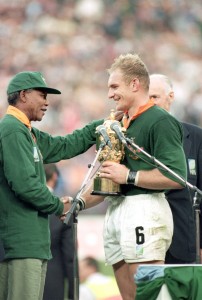
1995 Rugby World Cup - Nelson Mandela & Francois Pienaar
Quiet reflection
December 23rd, 2009. Published under AIDS, Nominees. No Comments.
Sitting in the sweltering bush, on a farm called Jejane, which borders onto the Kruger Park. My travel companions, photographer Pep Bonet and Joan have returned to Mallorca, the African bush now offers a perfect setting to disconnect and time for quiet reflection.
We have come to the end of 7 weeks of intense travel, interviews and pictures of approximately 30 remarkable South Africans spread across the country. As is always the case with time, it rushes past you at a slow and daily pace, our first day of arrival in Cape Town now seems an eternity and yet just a moment away.
Many have asked which have been the most inspiring encounters and who has left the greatest impact. Traveling over such an extended time with the sole purpose of seeking out the best in people has been one of the most privileged and rewarding experiences of my life.
It is often the most unexpected individuals that leave their greatest impact. The most moving and heartbreaking experience was traveling through the rural areas of KwaZulu-Natal. We had been offered two caregivers from the South Coast Hospice, south of Durban, as “guides” into people homes. During our final visit of the day we met with a family living in a small mud hut.
The mother is blind. She is a diabetic, and needs to inject herself daily with insulin, and she is HIV positive. Her four children, two teenage girls and two young sons take care of her. They used to live with their uncle, their mother’s brother, in a larger house with their extended family – until he found a medical card from the clinic that revealed her HIV status. She was kicked out, together with her four children, disgraced, disowned and stigmatized that her illness would soon “poison” the whole family.
The outcast family built themselves a new “home” using mud from the earth, sticks and grass. The hut is no larger than two single mattresses can be folded out in the night and the family can huddle together to sleep. They cook on an open fire in the corner of the hut, chickens wonder aimlessly through the doorless entrance, there is no water and no electricity.
We were greeted by the family with cautious smiles and welcoming gestures. The oldest girls were beautiful. Their clothes were tattered and worn and their feet thickly coated in the muddy earth that sticks to the soles of your feet during the rainy season. We spoke about their lives, their aspirations, the eldest daughter had been accepted into nursing school, and offered a bursary that would cover half of the fees. But she did not think she could accept, as she did not know where the other half of the money would come from.
Each of the children helped and guided their mother through her darkness. They took care of the cooking, the cleaning, growing vegetables and working the fields. They fetched water from the river each day and tended to the few chickens that pecked at the ground around us. Each day they would inject their mother with insulin, and ensure that her ARVs (antiretroviral drugs) were taken daily to ensure that AIDS was kept at bay.
I asked one of the girls if caring for their mother was a burden, and she looked at me with a puzzled expression “Of course not” she answered. “She is our mother.”
This family personifies the stigma of HIV and AIDS in South Africa. Their poverty and isolation was a stark reminder that this disease not only affects millions across the country, but ignorance continues to feed the epidemic, and the victims remain outcasts in many rural and urban communities. It is their resilience, the children’s unconditional love for their mother and their ability to hope that makes this family remarkable. They rank among the unsung heroes of the nation.
In deciding on which South Africans to interview, I realized that this list could be endless – there are so many remarkable individuals. I have also found that despite wanting to be impartial in my choice of interviewees, it was very difficult to separate HIV and AIDS from almost any cause in this country. It is rampant and rife – – it has penetrated all issues relating to education, children, women’s rights and sexuality, housing, politics, sports and jurisdiction.
Perhaps the only way to combat the spread of AIDS is by providing the young people with hope – because if they believe they have a future, they will make informed choices on how best to protect themselves and thereby allow themselves the privilege to dream.
Some become stronger in the broken parts
November 25th, 2009. Published under Nominees. No Comments.
I take a breath. The first in 2 weeks.
We arrived in Cape Town to blue skies and gale force winds. Pep Bonet the photographer, Joan Roig his assistant and post-production expert, and myself – travel companions for the next 6 weeks – embarking on a journey to document the lives of some inspiring individuals across South Africa.
The contrasts of South Africa are more evident than ever, as we cross social and economic boundaries, moving fluidly through people’s lives, listening to stories, sharing memories and taking pictures. We traveled daily between the affluent suburbs of Hout Bay, to the informal settlements of Joe Slovo and the shacks of Khayelitsha. A lot has changed in South Africa, but ignorance and fear continues to prevent people from crossing perceived racial and cultural barriers.
Khayelitsha lies at the doorstep of Cape Town, one of the worlds most cosmopolitan cities, where design, aesthetics and wealth create a dynamic and creative world hub – and yet 20 minutes down the N2 highway, lives a community of 2 million people, facing gross poverty, violence, limited health resources and access to basic needs of electricity and water.
We entered this space, looking for a glimpse of light in what we expected to be a sea of desperation and darkness – but instead found bright faces, people getting on with their lives, children’s clothes hanging brightly on washing lines, hair salons, street side vendors, music playing and people dancing to the beat. We were greeted with smiles, “hello sister” they shook my hand and made me feel that our presence was welcome.
Amongst others, we visited Vukani Centre, a day care center, caring for children with severe mental and physical disabilities. We observed women dedicated to caring and playing with the children. It was moving to see the love and tenderness extended to these children, and although the centre is strapped for resources, each child was cuddled, talked to and cared for.
As we left Cape Town early Monday morning, the mountain in our review mirror and drove through the lush Ceres valley into the Karoo, we were given 2 days to breathe in the vast distances and the rugged and unemotional landscape of the Karoo desert.
We now spend the next 2 weeks in Johannesburg. We have interviews scheduled everyday of the week – it will be a week of intense encounters.
In an interview with Johnny Clegg earlier this week, we spoke about those who had been left behind by South Africa’s transformation, those who had not benefitted from economic empowerment, and what it takes to overcome those challenges. The past 2 weeks of interviews have made me realize that each and every one of the people interviewed have had to persist through, what at times, have been life threatening challenges in order to achieve something remarkable. I left the interview with a powerful quote by Hemingway running through my mind: “The world breaks everyone, but some become stronger in the broken parts.”
The journey begins
November 11th, 2009. Published under Nominees, Progress. No Comments.
It has been a whirlwind week. I just got back from the Global Online Giving Marketplaces conference for which I was responsible for organising in Berlin. U2 set the stage for the 20 year anniversary of the fall of the Berlin Wall - a celebration of freedom, and a stark reminder, that the next global wall to fall is poverty.

U2 in concert in Berlin - 20th anniversary of fall of Berlin Wall, November 2009
Today a new journey begins. Together with photographer Pep Bonet (see www.pepbonet.com ) and his assistant Joan Roig, we fly to South Africa.
It marks the beginning of 6 weeks of travel throughout South Africa, documenting the lives of some remarkable individuals who are doing something exceptional with their lives. We will be holding interviews, taking pictures (photography equipment is being sponsored by Phase One Camera), and will allow ourselves to live with eyes wide open as we rediscover the country and its people.
Documenting the lives of these remarkable South Africans, has made me realise that as individuals, we are capable of infinitely more than the goals we have set ourselves to achieve.
I will keep you updated with our adventures via this blog.
Kindness is contagious
October 19th, 2009. Published under Nominees. No Comments.
“If I look at the mass, I will never act. If I look at one, I will” Mother Teresa
The scale of the challenges facing philanthropists are so excessive, that just the thought of it leaves you with an immediate onset of “compassion fatigue” - a term coined by Bob Geldof in the 1980’s.
I believe that we all have the capacity to be change makers - that change in society lies with the individual - one person reaching out to another.
I think back to what now seems like a surreal experience just over a year ago. It was one of those weeks, where destiny seemed to have it in for me, where I found myself on the receiving end of “goodness” and generosity.
I was visiting San Francisco for the Global Online Gving Marketplaces event at Stanford University, and had been offered a place to stay with a family I had never met. They welcomed me like an old friend (perhaps from a past life), cooked delicious meals, served sweet chai in the mornings and at the end of my stay they invited me to a small “meditation” gathering. Not too sure what to expect, but open to new experiences, I joined them to the gathering.
Apart from the mountain of shoes left at the front door, there was nothing out of the ordinary about the little suburban house. Inside poeple shared their prayers, their friendship and their silence. A wonderful meal was served, and everyone spoke in low voices - gently listening. And when leaving the meeting, I was given a handful of “smile cards”.
On the card is written - “Someone reached out to you with an anonymous act of kindness. Now is your chance to do the same. Do something nice for someone. Leave this card behind, and keep the spirit going!”
As I read Mother Teresa’s words this morning I was reminded that the stack of cards I was given are still lying in my drawer. I might have given 10 away in the last year - so have set myself the challenge to give back, by giving forward.
An article in last weeks Financial Times, “How to Spend it” edition (For Goodness’ Sake) reflects how giving is becoming a status symbol - a little like the trend that once saw the arts benefiting from spending by high-net-worth individuals - “Today’s philanthropists, it seems - especially the under 35’s - see themselves as global citizens, set to transform the nature of philanthropy through applying their considerable financial and intellectual resources to solve the global problems of our age.”
Not sure that smile cards are to solve the problems of our age - but change begins with the individual - and kindness is contagious.
PS. if you are needing some inspiration on how to make a difference: www.betterplace.org
Constitutionalism - our best hope.
October 7th, 2009. Published under Nominees. No Comments.
Inspired by the words of Justice Edwin Cameron, Constitutional Judge - a man deeply committed to his country - he speaks of his concern that the constitution, with its huge ambitions and promises, is in real jeopardy.
In a personal interview in August 2009, he reflects on what he sees are the biggest threats to our constitution:
1. Political will: judges do not have soldiers or policemen to enforce their orders. Orders must be enforced through the political systems and if politicians do not abide by the rule of law then there is no sense in the constitution.
2. Crime: how can you speak to an audience of people about legal rights and protections, if criminals are invading their personal security, bodily integrity, their safety, people are being raped, violated and terrorized. The crime wave is a terrible threat to constitutionalism.
3. Corruption: corruption is when people who are supposed to be serving the public, serve themselves. They steal from the public – time, money, resources. Corruption is a dire threat to constitutionalism.
4. Judges themselves who are dishonest, untruthful, who lack integrity, who are abusive of their office, who take under table payments, are a threat to constitutionalism.
5. Continued poverty: we have a grand constitution – but does it only serve the rich, the powerful and the comfortable? Is it really delivering for the people most in need of its promises? Unless the constitution has teeth for the poorest in our country , then we must stop talking in grand phrases – people can’t get bodily nourishment and shelter and protection from grand words - they have to be translated into action
“Constitutionalism and rule of law offers us our best hope.” Edwin Cameron
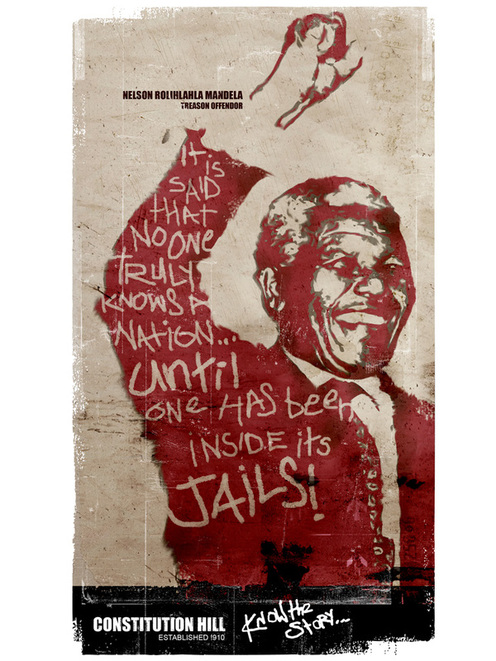
Poster series for the constitution hill, south africa. posters are based on historical political prisoners held at the old fort prison complex, which now houses south africa's constitution court.
A week behind schedule
September 25th, 2009. Published under Nominees. No Comments.
I sat down to write this blog post on Monday morning - and I look up to see it is already Friday!
So what happened this week?
Monday 21 Sept - This was a big day for activists around the globe!
World Peace Day. I have been following the work of Jeremy Gilley who conceived the idea of declaring one day a year free of conflict and war; one day of a global truce regardless of all kinds on world conflict and volatile situations.
His organisation Peace One Day is doing outstanding work - I hope to meet him personally in November at the Global Giving Markets conference I am organising in Berlin, 4 - 7 November (but that it a whole different story).
Then avaaz.org launched a global “Wake Up” action campaign - more than 2600 events in 135 countries across the globe,joined together to issue a deafening wake-up call to world leaders on climate change.
See video: https://secure.avaaz.org/en/sept21_hub/?cl=335795535&v=4114
Tuesday 22 Sept: New possibilities
The day started with a chat to a literary agent in Munich. I have decided that I need a professional to tackle the publishing world - it is a big place out there! But watch this space…
I chatted to Paul Bannister form the International Marketing Council who manages Brand South Africa. Looking through the list of “everyday heroes” listed on their site - I see this as a perfect partner for “Remarkable South Africans”.
Wednesday 23 Sept: Was not my day!
Received an email that a business association that I am closely linked to in SA has decided to withdraw their promised sponsorship of the Central Methodist Mission in South Africa (I proposed the CMM as a deserving initiative). There have been allegations of sexual abuse of a group of children at the church, where sexual “favours” have been traded for toiletries. Horrific - but sadly not the first time you hear of violence and sexual abuse happening in refugee camps - how could it not with over 3000 people trapped in a crammed building with no alternative to leave.
I see the withdrawal of support to CMM comparable to what “western” governments have tragically done for decades - as soon as the going gets tough - they pull out. And so when the needs are at their highest the most destitute are once again abandoned.
Thursday 24 Sept: Was that really only yesterday?
Immersed myself in the life of Miriam Cele. An outstanding woman dedicated to lives of orphans in KwaZulu-Natal. A devout woman with hands-on practicality: ”You can’t just keep on praying all the time. I mean saying to people even if they are hungry to say lets pray – it is ok to pray – but people need food in their mouths. I can’t wait for Sunday, I must do something.”
Friday 25 Sept: Catching up
Catching up on some SA news - pleased to see that school kids are holding their government to account, demanding libraries and access to knowledge.
G20 summit - You have to give Greenpeace credit for their stuntmen!!
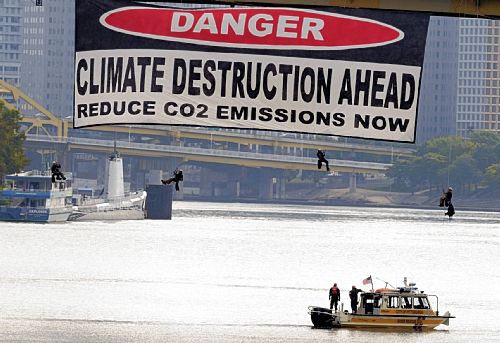
G20 - Greenpeace banner
Still a string of emails to reply to and stories to touch up on… weekend just around the corner…
It’s raining
September 14th, 2009. Published under AIDS, Nominees, Progress. No Comments.
Sitting at my desk, watching dark rain clouds bull doze across the Mediterranean towards Palma.
It is one of those Monday mornings where I would rather stay under the covers and immerse myself in Justice Edwin Cameron’s book “Witness to AIDS”, which has evoked feelings of amazement, respect and desperation at the thought of how much work still needs to be done to gain control of this epidemic that is raging through Africa.
I have never believed in chance - rather that meetings between people and encounters happen for a reason. Last week I met with Pep Bonet, planning our trip to SA in November. He told me of a wonderful woman who had worked for MSF in South Africa during the time when antiretrovirals were finally being made available to the public, in close collaboration with the Treatment Action Campaign. Marta Darder lives on Mallorca, and I met her for the first time for dinner in her home, and realised how inter-connected she is with the people and stories I have gathered in my quest for Remarkable South Africans over the past months.
She gave me a glimpse into the South African AIDS story - a gripping adventure, a tale of loss, compassion, desperation and hope. A demonstration of how legislation can be changed, governments can be challenged and change can be made through great commitment and well managed efforts of grassroots initiatives. And listening to Marta’s experience in SA, I also realised that it was the work of a close coalition of AIDS activists, led my Zackie Achmat and the Treatment Action Campaign that has ultimately saved the the lives of thousands of South Africans infected and affected with HIV.
Both Edwin Cameron and Hugo Tempelman - individuals who I have interviewed during my last visit to South Africa - have played an important role as part of “the coalition” in confronting the challenges of HIV/AIDS in SA. The South African AIDS story of human passion and sacrifice is a remarkable story unto itself - a next bestseller.
But now back to work - stories to write - I am on a privileged journey into the lives of truly inspiring South Africans.
AIDS FREE - THAT’S ME
September 3rd, 2009. Published under Nominees. No Comments.
… songs of hope…
The Star for Life program helps to give young people hope, dreams and the strength to live an AIDS free life (even if they are HIV +)
Back to work
September 3rd, 2009. Published under Nominees. No Comments.
Back at my desk after 4 inspiring and humbling weeks in SA.
Now the challenge is to capture these “great encounters” and stories shared onto paper in the first draft of “Remarkable South Africans”
Thank you to each person that I had the opportunity to interview - your lives are an inspiration!