Meet Ruth
November 1st, 2012. Published under Nominees. 1 Comment.
“I love children and don’t want to see them suffer. It’s better if they come here.”
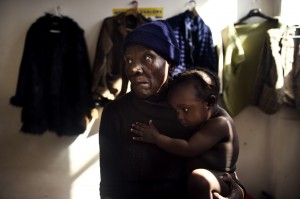
Ruth Manyike, refugee from Zimbabwe
In 2008, 53-year-old Ruth Manyike fled Zimbabwe. Her home was burned down by President Mugabe’s government supporters, and in her desperation she left her home and came to South Africa. Ruth arrived in Johannesburg with no money and no place to go. Along with many other forced migrants to the city, Ruth sought shelter in the Central Methodist Church, where the acting Bishop Paul Verryn opened his doors to refugees and the poor.
More than four years later, Ruth now lives on the eighth floor of a slum building in central Johannesburg - a building with no facilities; no water, no electricity.
Ruth speaks of her love for children, and how she worked as a child-carer in Zimbabwe. Although she feels that all has been taken from her, her compassion remains and so she has started her own informal child care centre in the building in which she lives.
Many of her neighbours in the building are blind or live with various physical disabilities. They find support in each other’s company by living together. The idea of creating a child care group came to her as she observed children of blind parents, being taken with them into the streets each day as the parents would beg at traffic lights and street corners. She offered to care for the children, saying:
“I saw the parents go down with the children in the morning. I asked them why they were taking the children with them, and they said that they wanted to go and beg for money, for food and clothes. I told them just because they cannot see, does not mean the children must suffer. Leave them with me, I will feed them what I have, and then you can come and collect your children in the evening.”
And so Ruth’s child care group was formed. She started with seven children, but word soon spread and she now takes care of 20 children in her room which stands empty during the day, but which she shares with up to five families at night.
“I tell the parents to pay me what they can,” she says. “I buy food for the children. In the morning they get porridge and tea. At one o’clock I give them food and after that, they nap. Then once they wake up, they are washed, smartly dressed, and the parents then collect them.”
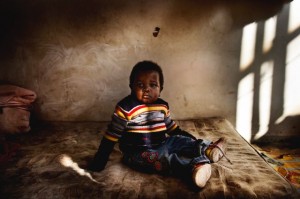
Children of the shadows
One senses the tension the moment one steps into the building and begins climbing the stairs to the eighth floor. The inside of the building is dark and stripped to its core, as rats scatter along the corridors and feed on the waste. However, the moment one steps out of the darkness into Ruth’s informal child care centre, the tension releases, as natural light streams through her windows and one is welcomed by a tumble of toddlers and children’s voices. Shy faces peek out from behind Ruth’s skirt, as the bolder children come to hold your hand with bright faces and a trusting smile.
Ruth is welcoming. She shares her story, and the challenges she faces. In the corner of the room she has buckets lined with newspaper set up as toilets for the children. Waste is carried down to bins on the street. She has a large plastic tub to bathe the children each day, and takes pride in ensuring they are fed and well kept and presentable when the parents come to collect them.
Ruth sings and dances together with the children, teaching them to count, learn letters and sing songs in English. The children range from a few months to five years old.
Ruth lives under the constant threat of eviction, as the landlord of the building demands that she pays rent for the room. She says she cannot afford what he is asking, and refuses, as there is no water, no electricity or security in the building. She guards her space with fierce determination for the sake of the children, as she confronts the constant threat of her room being hijacked from her.
Ruth is one of those silent heroes of society, a remarkable woman whose life of struggle is carved deep into the lines of her face; but her determination, her love and her calling to care for the children of the shadows can be seen in the depths of her eyes. The children who have passed through her hands will always know what it means to be loved.
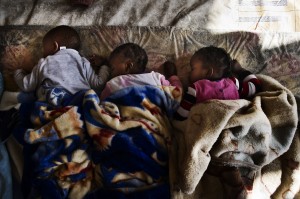
Children sleeping, in the care of Ruth Manyike
PICTURES BY PEP BONET www.pepbonet.com
Candice on February 21st, 2013
Can you add social media buttons to your stories? I read an article about Ruth that cares for the children of blind beggars in JHB. How can people get involved?