GirlZtalk Road Trip: Day 4
January 8th, 2014. Published under Nominees. No Comments.
07.01.14
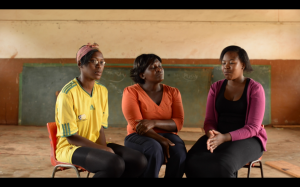
I reflect on the day and am left without words.
We have interviewed a small selection of the girls, who have come forward to share their stories – and they have left us speechless.
We listened to what these girls have experienced in their lives: the violation, the betrayal, the loss of loved ones - and then we see them rise. One realises how much they have had to carry with them, but there they stand with such grace, such humility and such strength.
It has been a day of tears, of memories, of girls sitting before camera sharing their stories - unravelling years of abuse that they have never spoken, not even to their families, but have chosen the “anonymity” of camera to share their brokenness.
I am reminded of Scilla Elworthy’s words: “The best place to act from is a broken heart, for it is only through the cracks that the light shines in.”
GirlZtalk Road Trip: Day 3
January 7th, 2014. Published under Nominees. No Comments.
06.01.2014
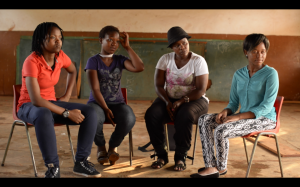
Let there be rain!!
Thick grey rain clouds have descended on the village, turning roads into rivers of mud and soaking the lush green vegetation in sheets of water.
We see girls arriving at the school hall, where we are holding our GirlZtalk workshops, their shoes filled with water, dodging the rain and gathering in the small groups under cover, waiting for the day to begin.
Our numbers have decreased by more than half; we imagine the rain kept many in their beds. We are now a group of 50 girls, an equal balance of SEED girls and local Venda girls, a core group who have chosen to be here.
Nikki, the workshop facilitator, starts the day with music. She asks the SEED girls to teach the local girls a song, and the local girls to teach the “township” girls a traditional dance. The girls come alive in music and dance, singing, dancing, and stamping their feet to the ground; closing the distance and cultural divide between the two groups.
As the girls start to open up and share their stories, they begin to focus on the issues that they feel most affect their lives. Emotional discussions on teenage pregnancy and violence against women raise the energy in the room.
Many girls say apathy and boredom are to blame for the high rate of teenage pregnancy. They say the information is available to them, condoms are everywhere, but a sense of “hopelessness” leaves the girls with little other focus. Others feel that the grants available to young mothers are an incentive to have children, but that the money is often spent in other ways and not for the child.
The local girls begin to show more confidence. They share their story of how the community has for some time been traumatised by a man who prowls the village raping women, the elderly and children. The women feel vulnerable, they fear for their daughters, and they feel that neither the police nor the community is able to stop him.
Another heated topic is education. All agree on its importance, but many feel that the system has failed them. Many of the girls complain that their teachers lack passion and commitment, and that the language of instruction is often in the local language because the teachers themselves lack the ability of teaching in English. Many of the local girls blame their poor English on their teachers, and the limited access to opportunity in their community.
The entire GirlZtalk process is being filmed. The rain has brought its challenges, and the Altamar film team – Pep Bonet, Jose Bautista and Reymond Mapakata – are forced to navigate the weather as the rain on the corrugated steel roof blurs the sound and limits the filming to classrooms rather than the open spaces.
However the generosity of our hosts continues to surprise us. With humble generosity they share their home, teach us their cultural practices and allow us to gain a deeper understanding of their lives – and as we talk and share our perspectives, we soon realise that we are not so different after all.
GirlZtalk Road Trip: Day 2
January 6th, 2014. Published under Nominees. No Comments.
05.01.14
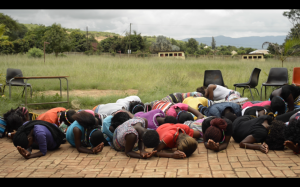
“uLosha!” someone cries out and all the women fall to their knees, hands together, heads bowed to the floor in the traditional Venda greeting. Nkosi - the chief - walks into the room, flanked by a council of men; he has come to bless the GirlZtalk workshop.
Some 130 girls crowded into the school hall, more than we had expected, (we later found out that some of the girls thought they were coming for a catering job and would get free bursaries?!) and we soon rush out to buy more food. Four women from the community have been designated as cooks, cooking in enormous pots on an open wooden fire. As we arrive with 50 kg of mielie meal, they shake their heads saying, “You think you are catering for Joburg girls? We are rural women, we like to eat a lot!”
We will be better prepared tomorrow!
Nikki Florence, who is facilitating the workshop, gets the girls activated. With formalities out of the way, the chief and his council leave the gathering – then Nikki starts with the ice-breaker games, dividing the girls into smaller groups, with at least 2 SEED girls to each group.
Nikki tasked the girls to list what they feel are the biggest challenges that girls face growing up in South Africa. She asks the girls to consider how the urban girls may have a different experiences to the rural girls, and where do they share common concerns.
Some of the issues that were chosen are:
VIOLENCE, DRUGS, POVERTY, HUMAN TRAFFICKING, EDUCATION, RAPE, TEENAGE PREGNANCIES
The day came to a close with a moving SEED girl’s performance, and a debriefing exercise that allowed each girl to reflect on the day’s experience. Tears filled their eyes as they started to shed their “city-life” guard, and were touched by the humility and generosity of the rural Venda community, who despite the few material possessions that they own, give generously of their homes and their lives.
Each girl then returned to their host families, and could be seen sitting outside, eating their meals with their fingers under the warm African sky.
Tomorrow the national matric results will be released, who knows how many girls will actually pitch now that they know there are no “quick-fix” job opportunities for the taking…??
But we do see how a little bit of hope for a better life can provide a source of strength that moves mountains! And we see the strength in their eyes.
GirlZtalk Road Trip: Day 1
January 6th, 2014. Published under Nominees. No Comments.
04.01.14
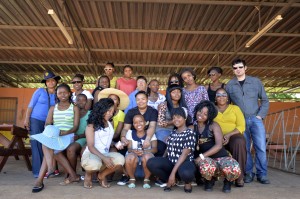
GirlZtalk Road Trip
GirlZtalk road trip, into the rural heartland of Limpopo, started in Johannesburg in the early hours of the morning. The streets seemed strangely empty, as the country slumbered, still savouring the end of the festive season. But two decorated mini-busses, parked on Ntemi Piliso street seemed to be buzzing with music , laughter and excitement as 20 SEED Community girls gathered to begin an 8 day road trip to Limpopo.
The purpose of the GirlZtalk road trip is to capture the distinct voices of girls, both urban and rural, as they explore the realities of what it means to be a girl growing up in South Africa today.
GirlZtalk aims to put a face to the overwhelming statistics of teenage pregnancies, violence, rape and poverty; issues that threaten to suffocate the voice of girls in many communities of our country.
We are on a trip to the village of Ha-Makhuvha, just 20 kilometers from Thohoyandou. As one turns off the road in Makhado, driving East into the fertile valley, the vegetation changes, becoming lush and fertile. Litchi plantations line the road to Thohoyandou, villages are scattered across the green hills and mangos hang heavy on the trees.
We arrived in the village of Ha-Makhuvha, where we will be spending the next 4 nights, and were greeted by the deputy chief Mashudu Vhulahani. To accommodate the SEED girls, families within the communities agreed to host us, welcoming us into their homes and ensuring a true cultural exchange experience.
The “township girls” have embraced the experience. Possibly the traditional sour pap is too bitter for the Joburg palate, and the language barrier needs to be navigated, but our presence feels welcomed and there is an anticipation of what the next days will bring.
TEDxBerlin talk - September 2013
December 10th, 2013. Published under Nominees. No Comments.
A pursuit into the lives African migrants living in the dark underworld of the inner city of Johannesburg.
As political and economic tides change across the African continent, Johannesburg stands as a beacon of opportunity; its bright lights are often blinding to the reality and hardship of the every day struggle for survival.
Each day thousands of forced migrants flood into Johannesburg in search of a better life. Many have risked their lives to cross South Africa’s borders, but on arrival face violence, discrimination and oppression, and in their desperation, individuals forsake their identity, their rights, and their health to survive.
Finding work dictates where people live, and they often resort to the only accommodation they can afford: the slum buildings of the inner city of Johannesburg.
The City of Gold
“Cry, the beloved country, for the unborn child that is the inheritor of our fear. Let him not love the earth too deeply… For fear will rob him of all if he gives too much.” Alan Paton
Johannesburg was built on the backs of mineworkers who, over a century ago, migrated from the rural areas to the city to work in the goldmines.
The city’s highrise buildings and skyscrapers are testimony to its wealth and prosperity, ranking the city as amongst Africa’s wealthiest and most modern cities – the city of gold.
However in the late 1980’s, South Africa was approaching the end of the dark era of Apartheid, where South African society had been segregated according to race: where the majority black population in South Africa had been oppressed and dominated by the minority white population.
Many white-owned businesses in the inner city of Johannesburg began to flee the city, and move their offices to other suburbs of Johannesburg. They literally emptied their buildings, locked the door and moved out, leaving behind a “ghost town”.
But what is a ghost town without it ghosts? The empty buildings soon became occupied, as people started moving into the buildings. What used to be old offices and boardrooms were subdivided and converted into people’s homes, as the city’s poor and destitute sought shelter in the abandoned buildings.
The Slum Buildings
According to Médecins Sans Frontières, there is an estimated 1300 slum buildings in the inner city of Johannesburg. The buildings vary in their scale of deterioration and level of basic infrastructure, but all face challenges of access to water, electricity and cleanliness.
Some of the slum buildings are hijacked buildings. Property owners have lost control of their buildings, the buildings are overcrowded, the lack of management have seen buildings deteriorate and become vandalised and many of the buildings are run by slum lords and gangs, who demand rent from tenants although in many cases there is no running water, electricity or cleaning of the buildings.
The buildings are overcrowded, where the fight for survival is brutal and unrelenting; many of the residents are desperately poor, and each day is a struggle to survive. The people who live in the buildings are both South Africans and foreigners. Many are refugees who have crossed the border illegally; they fear deportation and police brutality, and therefore choose to become “invisible”- which makes them more vulnerable to abuse, violence and discrimination.
Many live under the constant threat of eviction and fear confrontation with the police. Living in the shadows of Johannesburg, their existence is not recorded and the majority have no documentation to prove their identity.
Although there are no one accurate figures, there are an estimated 250.000 people who live in the “underworld” of the inner city, residing in places that are not suitable for human habitation.
The slum buildings have no cleaning services, there is no sewerage systems, there are rats, there is no water, no electricity - the buildings are like vertical squatter camps, they are dangerous, they are dark and they are considered unsafe, especially for women and children.
The gateway to the underworld
The gateway to the underworld of the inner city lies in an unlikely place – the Central Methodist Church, which is situated in the centre of the city, right beside the High Court in Johannesburg.
The church has a rich and important history in Johannesburg, it is being led by Bishop Paul Verryn, a man who has dedicated his life to fight for the rights of the city’s poor and destitute.
In 2008, there was a wave xenophobic attacks across South Africa, where foreigners were being targeted, beaten, killed and harassed. In response to the attacks, Bishop Paul Verryn opened the doors of his church to the refugees and foreigners, and before he could knew what was coming, some 3000 people flocked into the church for shelter. Those who could not fit into the building slept on the streets outside in front of the church.
The church has become a gateway to the underworld. It is well known across Africa as the first point of entry for refugees arriving in Johannesburg. It is a place of shelter, and is the “eye of the needle” through which one passes into a harsh reality that awaits people in the tough streets of Johannesburg.
The Central Methodist Church has been the social battleground between the Government, the police, human rights lawyers and NGO’s, who have grappled with taking responsibility and dealing with the influx of refugees to the city.
The Solution
Cities are not only built with bricks and cement, by architecture and design – cities are built through the lives of those who live there.
The inner city of Johannesburg is socially complex, politically contentious, and the contest for space, for jobs and survival pushes individuals to extremes.
The solution to the inner city lies in a joint venture between the city’s stakeholders: the City Council, property developers, the private sector, NGO’s and civil society who all have an important role to play in dealing with the preservation of building stock whilst addressing the fundamental human rights of the residents of the inner city.
If Government were to outsource and fund the creative solutions presented by the private sector in servicing the poorest of the poor; and NGO’s delivered solutions to the social needs of those who live in Johannesburg; whilst engaging in the voice of civil society through institutions such as the Central Methodist Church, one would be a step closer to providing a holistic approach to the city, and fulfil the promise of the nation to be a leading African city.
Link to Into the Shadows Trailer:
www.intotheshadows.org
1st Prize, World Press Photo Awards, multimedia online short category
APA, American Photographic Artists – Best Spot News/Editorial Feature
Remarkable Palestinians
November 29th, 2013. Published under Nominees, South Africa, Stories. No Comments.
Some months ago, I was approached by an organisation called NIJMAH* (in Arabic meaning ‘star’) asking about my book Remarkable South Africans. NIJMAH* recognises synergies between the Palestinian struggle for freedom and the South African struggle during Apartheid, and believe that there are lessons to be learned from South Africa that could benefit the Palestinian people.
NIJMAH* asked if would be interested in writing another book? Remarkable Palestinians would be a quest to capture the best of the human spirit in those who strive for peace, freedom and dignity in one of the most complex human conflicts in history.
My immediate reaction was – of course! I have never been to Palestine or Isreal for that matter, and welcomed the thought of a new adventure. I believe that the essence of humanity, the spirit of Ubuntu, can be found in all cultures, amongst all peoples, and being on a quest to seek out the best of human beings is an inspiring and an awakening journey of the mind and spirit.
Soon after, one of the founders of NIJMAH*, Jamila (half German half Palestinian) and her boyfriend Omar (Palestinian) came to Mallorca where I met them for a coffee for the first time. We talked, and shared our vision for creating a book called Remarkable Palestinians, and I soon realised that I knew very little of this complex nation.
I also realised that my life had only ever been exposed to the Isreali perspective. Many of my dearest and oldest friends are South African Jews, a community of people I came to deeply respect, know and admire. I remember feeling like a welcomed outsider; wanting to belong, although my cheese burger and Scandinavian blonde hair only highlighted the invisible religious line that I clumsily stumbled across, only to be escorted back into my side of the territory with a broken teenage heart and questioning if love can truly conquer all?
Jamila and Omar came to stay with us for one night. They are a creative and passionate couple. Jamila played the piano and sang for us, Omar told me about his life growing up in the Arab quarter of Isreal. They are both passionate about Arabic culture, music, film and deeply passionate about expressing the Palestinian struggle through art.
We brought out an atlas and they talked me through history. History always depends on those who write it, and is often interpreted through ones own experience and belief. I felt sobered. Saddened as I listened to stories of lives destroyed, and yet inspired hearing of individuals who rise, who seek peace, who are willing to forsake all to fight for freedom through non-violent means. I felt ignited at the great capacity of individuals to serve humanity – and yet I felt utterly confused.
I had agreed to write and produce Remarkable Palestinians on the condition that my writing would be independent, that I would always remain neutral. But my own words bothered me, as the words of Archbishop Desmond Tutu ringed in my conscience – “If you are neutral in situations of injustice, you have chosen the side of the oppressor.”
I realise that I am stepping into an emotional minefield. I may possibly be forced to take sides, in a battle which is not mine. I am neither Palestinian nor Isreali, neither Muslim nor Jew, and once again will be crossing an invisible line into a territory in which I do not belong. But I do believe that there are human qualities that belong to all of us, and I also believe that being an outsider may just allow me into the hearts of those whose stories I hope to write.
I have been tasked with a great mission – to seek out the best of the human spirit.
I remember, many years ago, deeply questioning my own spiritual journey, confronting what I felt were limitations to Christianity. A scripture in the Bible says: “The only way to the Father is through the Son” which I felt excluded so many segments of humanity. But then a dear friend (a Jewish friend), said to me:
“Jesus is love, right? Then the only way to the Father is through Love.”
The words set me free – and enabled me to understand that if we act and live according to LOVE – then the words Freedom, Peace and Dignity are qualities that belong to all of humanity.
NIJMAH* is crowd funding the first phase of the project. If you want to be involved, follow this way: http://www.betterplace.org/en/projects/15065-remarkable-palestinians-creating-an-inspiring-book-working-title
Through the cracks, the light shines
September 6th, 2013. Published under Into the Shadows, Stories. No Comments.
Today has been a day rich in content, broad in scope and refreshing in its variety of personal encounters and new perspectives.
I have spent the day at The DO School in Hamburg, and feel enriched by the energy, the creativity and the belief that the world is being changed in a meaningful and inspiring way through the joint efforts of focused individuals who are passionate to make a difference in the world.
The Do School runs a social entrepreneurship MBA programme, where fellows from across the globe are accepted to take part in a year of creative learning and developing their social impact idea. It made me want to be 25 years old again, and be a student in such a dynamic multi-cultural environment with youth that are destined to be change makers in this world.
I was just passing through Hamburg, but in my passing I met some phenomenal individuals, and amongst them was a woman called Scilla Elworthy: a woman who has dedicated her life and work to promoting peace around the world, has been nominated three times for the Nobel Peace Prize, a woman of presence, with a remarkable story.
I was lucky enough to listen in to the end of a group discussion between Scilla and the fellows. Scilla was speaking about her own experiences in South Africa, working with children, her experience with refugees and minority group, and her passion to promote peace across the world through an organisation she founded Peace Direct.
Then one of the fellows asked her: “How do you manage to work with these topics without breaking your heart?”
And she poignantly responded: “Your heart does break, but does that matter? The best place to act from is a broken heart, and it is only through the cracks that the light shines in.”
Her words struck me, as I realised that my own broken heart is also my source of strength. I have often struggled with having to reconcile my life of privilege with all that I have seen and met in working in the shadows of Johannesburg, and in producing documentary films that share the stories of the dark side of humanity.
Scilla spoke of the great source of strength that we all carry within us, and how practices such as meditation opens up an infinite supply on inner strength to live with passion, the lives that we are destined to live.
Now my journey continues on to Berlin. The beginning of 3 days of TEDxBerlin, surrounded by inspiring speakers, storytellers and visionaries of our time. I feel priviledged to be counted amongst them – an opportunity for light to shine through the cracks into the underworld of the inner city of Johannesburg.
HAPPY BIRTHDAY MADIBA
July 18th, 2013. Published under Nominees. No Comments.
“I have walked that long road to freedom. I have tried not to falter; I have made missteps along the way. But I have discovered the secret that after climbing a great hill, one only finds that there are many more hills to climb. I have taken a moment here to rest, to steal a view of the glorious vista that surrounds me, to look back on the distance I have come. But I can only rest for a moment, for with freedom comes responsibilities, and I dare not linger, for my long walk is not ended.” Nelson Mandela
No Escape: child slavery
July 10th, 2013. Published under Nominees. No Comments.
The team is back to work – Pep Bonet, Jose Bautista and myself – we are creating a body of documentary work on child slavery in 3 continents.
The first chapter covers child labour in Bangladesh, from where Pep has returned with striking images and moving testimonies. We have spent the last few days building the storyboard, creating a script, editing film, selecting images and piecing together a powerful and heart breaking story, told through the testimonies of children in Bangladesh.
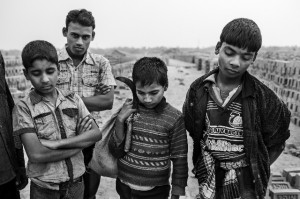
Boys working in a brick factory. Picture by Pep Bonet
The multimedia documentary tells the story of children who work in brick factories, garbage dumps and as street sellers. In most cases the children do not go to school; their families are desperately poor, and the income that the children bring home secures that the family survives. Child labour is technically illegal in Bangladesh but extremely widespread.
From the busy streets of Dhaka, the story moves into the dark alleyways of Tangail Brothel, which is one of the biggest brothels in Bangladesh.
Inside there are 800 rooms and around 900 commercial sex workers that work and live there, many of them are children and imprisoned against their own will.
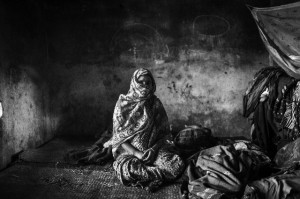
Girl forced into being a sex worker when she was 14 years old. Picture by Pep Bonet
Personal testimonies of the girls who have been sold into the sex trade are almost unbearable to listen to:
“It is unspeakable. Everyday from 7am – 7pm, customers are coming one after another. One customer brought 4/5 persons with him. Another customer brought 3 or 4 persons with him. We also had to do night duties. At night everyone has to take two persons. You cannot sleep. You just have to work. No one is allowed to sleep. If someone went to sleep, she (the boss) beats you.” Moyna was sold into the sex trade when she was 14 years old.
The sex trade in Bangladesh is expanding at an unprecedented pace and touching every strata of society.Over the last decade thousands of Bangladeshi girls were lured under false circumstances and sold into the sex industries in different countries including Bangladesh.
South East Asia is by far the region where slavery is most thriving and culturally complex.
The International Labour Organization (ILO) estimates that there are about 250 million children working worldwide. We have just scraped the surface – the reality of child slavery is widespread and culturally complex, and prevalent closer to home than any reader of this blog would like to believe.
We will be using the Bangaldesh multimedia documentary to launch the project, and use it to look for funding to cover an in-depth initiative that aims to document child slavery across 5 countries in 3 continents.
This is a story told by children who live in realities from which there is no escape.
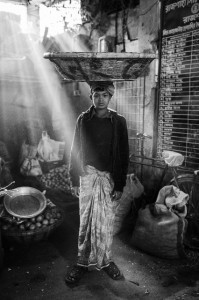
Storytelling
May 10th, 2013. Published under Stories. No Comments.
History depends on those who write it - it is not about dates and places and wars – but about the stories that fill the spaces between them.
Mother Teresa’s said “If I look at the mass I will never act, if I look at one, I will.”
Psychological studies have proved her words to be true, and have shown that statistics have a dulling effect on people, but that individual stories will move people to act.
When a group of people is asked to donate to a humanitarian cause, and are given a choice: either to alleviate hunger in Ethiopia, or to support a little girl called Shela who lives in a rural village in Ethiopia, and everyday has to struggle to find food – many more people are willing support Shela rather than a greater cause that addresses global hunger.
Storytelling has featured throughout history, the challenge is how to best tell that story so as to affect positive change in society?
Whilst attending this year’s World Press Photo Awards, I listened in on most of the presentations given both by photographers and analysts in the field who were invited to share their story.
What struck me most, was during the presentations when winning photographers presented their body of work in the form of a visual slide show, those presentations that were combined with music and sound had far greater impact. Those that were silent and left you only with the visual presentation opened a room for distraction, as the sounds of the audience – a chair moving, someone coughing, people whispering – distracted the attention from the work. It highlighted, for me, the importance of multimedia – the visual, the sound and the storytelling – and how we can optimize the medium of storytelling through combining all these senses.
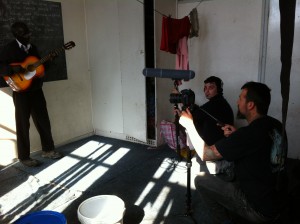
Also listening to Dr David Campbell’s presentation on his research project “Visual Storytelling in the Age of Post-Industrialist Journalism”, once again highlighted that the role of multimedia in journalism is becoming increasingly important.
I believe in the power of story telling as a driving force to connect humanity and thereby make a difference in society. In my work as a writer and journalist, my objective is to document real life stories and to give a voice to those who have otherwise been silenced by history.
I believe there is great strength in collaboration. I see the medium of storytelling evolving into a multimedia space, where the perspectives of photographers, filmmakers, audiographers and writers can combine their work to create powerful and meaningful stories.
May history never turn around and say “we did not know”.