“Into the Shadows” Team
May 10th, 2013. Published under Into the Shadows, South Africa. No Comments.
“If you want to go fast - go alone. If you want to go far - go together”
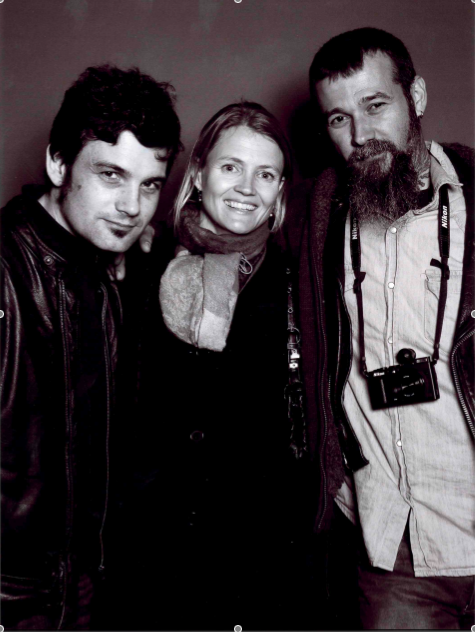
Winning Team: Jose Bautista, Line Hadsbjerg, Pep Bonet - 1st Prize, World Press Photo Awards 2013, Multimedia Online Short
This is what Jury chair Keith W. Jenkins commented about “Into the Shadows”: “It was one of a handful of entries that made the transition between photography and video virtually invisible. The piece began with wonderful still images that were well photographed, with great framing, and then the story unfolded with great video clips that explained everything that the stills revealed. It was an effortless piece, well constructed, and filmed and shot all in black & white, with immaculate print and superb attention to detail. It was clear to me, and to all the judges, that the production team really understood lighting both for stills and video, and never for a moment did you feel that you were being taken out of the moment – your attention was held the whole time.”
Jenkins added: “It was tight, emotional storytelling at its very best, with an economy of words, great pacing and a clear understanding that you need space and air between thoughts and concepts so they can be processed and sink in. It did all of that and didn’t miss a beat.”
Syria - “Gift of the Givers”
April 18th, 2013. Published under Nominees, South Africa. No Comments.
Imtiaz Sooliman, Founder of Africa’s largest disaster relief organisation “Gift of the Givers”., and also one of the inspiring individuals featured in my book “Remarkable South Africans”, together with his team continues to touch lives across the globe.
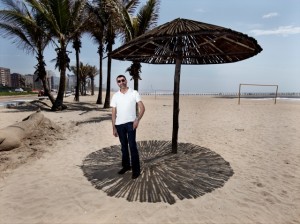
Imtiaz Sooliman, Founder of "Gift of the Givers" | Picture by Pep Bonet
This week “Gift of the Givers” has sent a medical team to Northern Syria, and Imtiaz Sooliman has sent out this moving letter documenting their experiences:
“Dear Recipients
The mood of the medical team is upbeat, slowly having coming to terms with the continuous sound of shells and the staccato of gunfire around the city in these last few days. This is Day three; the anticipation and the excitement to serve and save enhanced by the vehicle congestion in the streets and the throngs of people in the hospital foyer. They came in their numbers from all over North Syria; the word is out that the foreign medical team has finally arrived. The theatre cases line up, children, dental and non-emergency cases re-directed to our new outpatient clinic opened 24 hours previously, women in droves wait for the gynae; the casualty area is already flooded, field teams report huge numbers from the satellite clinics we’ve set up. There is a hive of activity, the excitement palpable with every patient tugging at our sleeve as a desperate population eagerly seeks quality health care disrupted by two years of ongoing civil conflict. The medical team are in their element, overjoyed and content. This is what they came for, to serve with distinction, to bring hope and to heal physically and emotionally. In less than 48 hours more than 500 patients have already been treated including the delivery of twins and several surgical procedures.
The rhythm and calm ominously interrupted by a traumatic, unfortunate emergency; a child has been shot in the chest by accident. Our trauma team calmly steps in with frenetic reaction time, all the protocols are followed as this is what we do best. The seconds tick by, for the father an eternity as he holds the ankles of his child lovingly with that tear-jerking look on his face. Oh! that look. We gently move him away as realisation dawns that we’ve lost the child. Words cannot describe the anguish of the mother, her body language, her wailing and the pain. The wind is knocked out of our sails, we lose momentum. Our day is messed up. We sit down, this is a day of great sadness for us but a very normal day for the Syrian people who lose 200 lives daily. The emotions have to be postponed; people want to be healed, lives have to be saved. We hasten back to work.
Imtiaz Sooliman
Darkoush
Northern Syria”
Oscar Pistorius: our fallen angel
February 22nd, 2013. Published under Nominees, South Africa. No Comments.
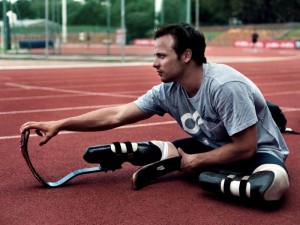
Picture by Pep Bonet
I write these words with bated breath. Live twitter updates are rolling in on my screen from the court room where Oscar Pistorius applies for bail after being charged with murdering his girlfriend, Reeva Steenkamp.
The media hype around Oscar Pistorius has captivated me, and most of the world, every day since that fateful morning 14 February 2013.
I can’t help but ask: what is it that makes me ache with regret, and pity, and deep sadness for Oscar Pistorious. I feel a sense of guilt just writing these words, because my heart should lie with Reeva, her family and their loss! And it does – they have lost their angel, and their mourning has been silent and gracious.
However, Oscar dominates my thoughts, my dreams, and in my quiet moments I ask the hands of the universe to hold him.
On the same day that Reeva got shot, I was dancing alongside women across the globe in celebration and awareness of the “One Billion Rising” campaign against abuse and violence against women. And yet, my thoughts lie with a man who once again turned the woman he loved into his victim, and fatally shot and killed her.
Why on earth should I care for him?
I try to find an answer in the fact that he is someone I have personally met. Someone I liked and admired, who features in my book “Remarkable South Africans” – a documentation of inspiring individuals who have contributed to humanity and uplifted the nation. He deserved his place amongst the very best of our citizens.
We built him a pedestal in the sky, we sang his praises, we believed in him, we invested our identity in his success and glowed with pride to see him carry the South African flag - and so even greater is the fall, dragging us with him as he tumbles.
I curse him for his carelessness, for his brutality – and yet a silent part of me hopes, prays, that Reeva’s death is a result of a foolish mistake, and not premeditated murder.
What society have we created that “sanctifies” violence? Do the guns we carry to protect ourselves, instead place the lives of our loved ones at risk? Have we forgotten the promise of Mandela as we see our heroes turn to beasts? And what of the women – our mothers, our sisters, our little girls - every 17 seconds a woman is raped in South Africa, and by the time you have read this article at least 7 women have suffered the greatest violation of their bodies and spirit by a man.
Oscar Pistorius will pay his price – he already has - and this is just the beginning of a long dark road that lies ahead of our “fallen angel”.
And may Reeva’s death echo the words of the poem “Still I rise” by Maya Angelou
You may write me down in history
With your bitter, twisted lies,
You may trod me in the very dirt
But still, like dust, I’ll rise.
Does my sassiness upset you?
Why are you beset with gloom?
‘Cause I walk like I’ve got oil wells
Pumping in my living room.
Just like moons and like suns,
With the certainty of tides,
Just like hopes springing high,
Still I’ll rise.
Did you want to see me broken?
Bowed head and lowered eyes?
Shoulders falling down like teardrops.
Weakened by my soulful cries.
Does my haughtiness offend you?
Don’t you take it awful hard
‘Cause I laugh like I’ve got gold mines
Diggin’ in my own back yard.
You may shoot me with your words,
You may cut me with your eyes,
You may kill me with your hatefulness,
But still, like air, I’ll rise.
Does my sexiness upset you?
Does it come as a surprise
That I dance like I’ve got diamonds
At the meeting of my thighs?
Out of the huts of history’s shame
I rise
Up from a past that’s rooted in pain
I rise
I’m a black ocean, leaping and wide,
Welling and swelling I bear in the tide.
Leaving behind nights of terror and fear
I rise
Into a daybreak that’s wondrously clear
I rise
Bringing the gifts that my ancestors gave,
I am the dream and the hope of the slave.
I rise
I rise
I rise.
1st Prize - World Press Photo - Multimedia
February 2nd, 2013. Published under Nominees. 1 Comment.
Today has been a good day!!
Our multimedia “Into the Shadows” won First Prize at World Press Photo Awards, “online short” category.
Our hope is that this important story will help shine a light “into the shadows” of the inner city of Johannesburg.
I feel honoured to be part of such a great team - Pep Bonet and José Bautista
Despite the loss, the despair, the violence and the hopelessness, we have been deeply moved by the calibre and integrity of the people we have met. The resilience, the sacrifice, the intellect. The poor are neither uneducated nor ignorant. They are resourceful, they are sceptical, they are articulate and the vast majority have hit the ground running and are desperate to live, to be respected and to be given the opportunity of a better life.
Humanity
January 17th, 2013. Published under Nominees. No Comments.
“There is only one way in which to endure man’s inhumanity to man and that is to try, in one’s own life, to exemplify man’s humanity to man.” Alan Paton
Meet Ruth
November 1st, 2012. Published under Nominees. 1 Comment.
“I love children and don’t want to see them suffer. It’s better if they come here.”
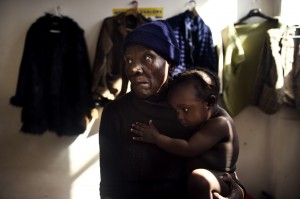
Ruth Manyike, refugee from Zimbabwe
In 2008, 53-year-old Ruth Manyike fled Zimbabwe. Her home was burned down by President Mugabe’s government supporters, and in her desperation she left her home and came to South Africa. Ruth arrived in Johannesburg with no money and no place to go. Along with many other forced migrants to the city, Ruth sought shelter in the Central Methodist Church, where the acting Bishop Paul Verryn opened his doors to refugees and the poor.
More than four years later, Ruth now lives on the eighth floor of a slum building in central Johannesburg - a building with no facilities; no water, no electricity.
Ruth speaks of her love for children, and how she worked as a child-carer in Zimbabwe. Although she feels that all has been taken from her, her compassion remains and so she has started her own informal child care centre in the building in which she lives.
Many of her neighbours in the building are blind or live with various physical disabilities. They find support in each other’s company by living together. The idea of creating a child care group came to her as she observed children of blind parents, being taken with them into the streets each day as the parents would beg at traffic lights and street corners. She offered to care for the children, saying:
“I saw the parents go down with the children in the morning. I asked them why they were taking the children with them, and they said that they wanted to go and beg for money, for food and clothes. I told them just because they cannot see, does not mean the children must suffer. Leave them with me, I will feed them what I have, and then you can come and collect your children in the evening.”
And so Ruth’s child care group was formed. She started with seven children, but word soon spread and she now takes care of 20 children in her room which stands empty during the day, but which she shares with up to five families at night.
“I tell the parents to pay me what they can,” she says. “I buy food for the children. In the morning they get porridge and tea. At one o’clock I give them food and after that, they nap. Then once they wake up, they are washed, smartly dressed, and the parents then collect them.”
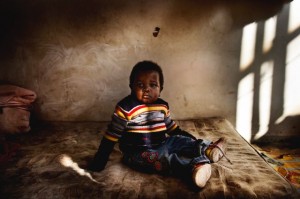
Children of the shadows
One senses the tension the moment one steps into the building and begins climbing the stairs to the eighth floor. The inside of the building is dark and stripped to its core, as rats scatter along the corridors and feed on the waste. However, the moment one steps out of the darkness into Ruth’s informal child care centre, the tension releases, as natural light streams through her windows and one is welcomed by a tumble of toddlers and children’s voices. Shy faces peek out from behind Ruth’s skirt, as the bolder children come to hold your hand with bright faces and a trusting smile.
Ruth is welcoming. She shares her story, and the challenges she faces. In the corner of the room she has buckets lined with newspaper set up as toilets for the children. Waste is carried down to bins on the street. She has a large plastic tub to bathe the children each day, and takes pride in ensuring they are fed and well kept and presentable when the parents come to collect them.
Ruth sings and dances together with the children, teaching them to count, learn letters and sing songs in English. The children range from a few months to five years old.
Ruth lives under the constant threat of eviction, as the landlord of the building demands that she pays rent for the room. She says she cannot afford what he is asking, and refuses, as there is no water, no electricity or security in the building. She guards her space with fierce determination for the sake of the children, as she confronts the constant threat of her room being hijacked from her.
Ruth is one of those silent heroes of society, a remarkable woman whose life of struggle is carved deep into the lines of her face; but her determination, her love and her calling to care for the children of the shadows can be seen in the depths of her eyes. The children who have passed through her hands will always know what it means to be loved.
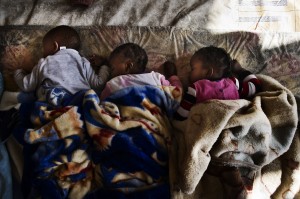
Children sleeping, in the care of Ruth Manyike
PICTURES BY PEP BONET www.pepbonet.com
“I will tell your story…”
October 17th, 2012. Published under Nominees. No Comments.
“I will tell your story if you try
but how long will your thoughts
of valleys stay green
when the world you were born in
changes with seasons
Will you run with this dream, will you run along
or will you run against and finally reveal
why some die young”
Interview at The Red Zone, 2.10.2012
October 4th, 2012. Published under Nominees. No Comments.
Zuma’s Mistress
September 13th, 2012. Published under Nominees. No Comments.
If Zuma is Chief, Johannesburg is his mistress. She sits alongside him at the head of the table and feeds on the country’s riches.
She is powerful, charming, with a sparkle in her eye and gold rings on her fingers. She feeds on her own wealth, with greed and a gluttonous appetite, chewing on the meat, spitting out the bones. She has lined her streets with gold, and shined up her façade; she likes best the company of the bold, the beautiful and the spectacularly rich.
She has built her skyscrapers on the backs of mine workers, and all who followed them to the promise of a better life, a share in her feast.
But amidst her glitz, her glamour and her empty promises, she hides her dark infested underbelly. A place where those that are of no use to her reside. They live amongst the rats in darkness: scrambling, clawing, desperate to survive. For more than a century they have been feeding her insatiable appetite, receiving very little in return.
She houses them in slum buildings, leaving them to live and breathe in her filth. To silence their discontent she threatens violence, persecution and deportation. But the pressure makes her sweat the blood and tears of those whose dreams are crushed by her weight, her disregard and her nepotism.
And should one day the bones of those that were cast aside, through fear and anger begin to rise… In one last desperate effort to rise in revolt, in fury, in revolution against her. Will her blood stained hands with bloated fingers be able to silence the voices of history? Will they come back to haunt her, rob her, and rape her of her riches, and will the “fat cats” that feast at her table come to protect her?
And in her cries will we hear the echo…”one day when they are turned to loving, they will find that we are turned to hating.”
Into the Shadows - TEASER
September 6th, 2012. Published under Nominees. No Comments.
Documentary film “Into the Shadows” teaser is “hot off the press”.
“Into the Shadows” is a pursuit into the lives of hundreds of thousands of Africans living in the inner city of Johannesburg. They are urban survivors: their stories remain untold, their existence is unrecorded and their voices unheard - but their harrowing stories cast a shadow on Africa as a whole.
Our goal is to produce a documentary film that documents the dark underbelly of the inner city of Johannesburg: the slum buildings, the struggle for survival as migrants, refugees and local South Africans compete for jobs, for accommodation, for food and for a better life.