Into the Shadows - the team
July 16th, 2012. Published under Into the Shadows, South Africa. No Comments.
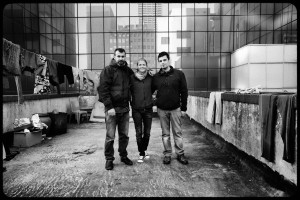
Standing on the rooftop of the Central Methodist Church in Johannesburg whilst producing the documentary film “Into the Shadows”.
Pep Bonet, Line Hadsbjerg & Jose Bautista
Into the Shadows - a reflection
July 7th, 2012. Published under Nominees. 1 Comment.
We arrived in Johannesburg to blue skies and a winter chill. Our goal was to produce a documentary on the inner city of Johannesburg: the slum buildings, the people, the struggle for survival as migrants, refugees and local South Africans compete for jobs, for accommodation, for food and for a better life.
I had expected of myself to be writing a daily blog of our experience of the inner city of Johannesburg. I intended to describe the slum buildings, portray the people we met and share our experience of the “shadows” with those who may live on the periphery of the city, and beyond, who prefer to keep its threatening streets at a distance.
However, at the end of each day I have found myself to be wordless – “intense” – the only word I could find to describe my day’s experiences.
The weight of the concrete, the high rise buildings, the tension and the stress of watching individuals: mothers, children, young men, old men, foreigners, South Africans – people – just trying to get on with their lives. Just trying to survive this urban beast that slowly robs you of your identity.
I have driven out and across the railway line at dusk every evening. I have felt the tension of the city release its grip with each kilometre I drive away from the inner city, but at the same time a growing tension within me as I try to reconcile the comfort of a home in the northern suburbs to the reality of the people and living conditions I have seen and met each day.
From the comfort of my warm bed, Johannesburg blows a cold chill into my dreams. I lie and think of the people huddled together at night, claiming a piece of cardboard as their bed. Mothers tucking their children close to them, offering their bodies as the only protection.
I have lost my appetite to abundance, knowing that my leftovers would be enough to feed someone’s hungry stomach.
Despite the loss, the despair, the violence and the hopelessness, I have been deeply moved by the calibre and integrity of the people we have met. The resilience, the sacrifice, the intellect. The poor are neither uneducated nor ignorant. They are resourceful, they are sceptical, they are articulate and the vast majority have hit the ground running and are desperate to live, to be respected and to be given the opportunity of a better life.
Johannesburg: you feel its heartbeat as you walk the streets. It is alive, it moves, it pulsates with energy - and slowly kills you.
Twitter: follow us into the shadows #intotheshadows
Africa sky blue
June 27th, 2012. Published under Into the Shadows, South Africa. No Comments.
We stepped out of the Swiss Air flight this morning, into a crisp, bright winter morning. The smell, the dryness, the brown grass, the grey haze fading into blue Joburg skies - it felt good to be back.
My travel companions are photographer Pep Bonet (www.pepbonet.com) and sound-recorder/audiovisualist Jose Bautista (www.kanseisounds.com).
This is the beginning of 2 intense weeks, stepping into the underworld of Johannesburg city into the lives of some 250.000 “forced migrants” who occupy over 1.000 buildings in the inner city.
“Into the Shadows” will form a body of documentary work: written testimonies, pictures and a documentary film of the urban slum buildings in the inner city of Johannesburg.
My intention is to Tweet (follow on: #intotheshadows ) and Facebook our experience of the inner city and its people.
I thereby invite you to join us on our journey into the shadows…
Good bye Professor Tobias
June 7th, 2012. Published under Nominees. No Comments.
Good bye remarkable old man – today you left this world but your life will remain in the memory of humanity for all time!
In writing my book Remarkable South Africans, Professor Phillip Tobias was one of my favourite interviews. His humour, his wisdom, his quiet murmerings to the ancient sculls he held in his hands - a truely remarkable individual.
In his memory, I include herewith some of the quotes from the interview, some of which were not published in the book, but I am glad that I kept record of his words and share them with you here.
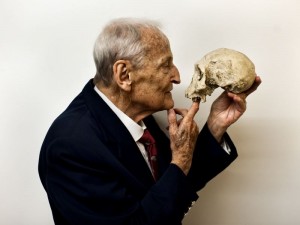
Professor Phillip Tobias - Paleoanthropologist
The evolution of mankind: “There are many gaps in the story [of humanity] that we haven’t filled. Each discovery gives us a new revelation which we hadn’t expected – the whole point of discovery is that you don’t expect it – it is handed to you.”
Reflections on Apartheid: “Universities had cherished their freedom, to appoint whom they wished, to accept as students whom they wished, to teach what they wished. Apartheid was then, not only a monumental racist system, which was besetting our country, and lasted for over 40 years, but also it was an onslaught on academic freedom.”
Survival of the species: “Whether it be pollution, excessive urbanisation, whether it be crime as a kind of urban pathology, if we have had the wit to create the problems, to create the circumstances in which the problems came into being, I think we have the wit to devise solutions. I think we shall survive… I am not one of those little men that run from conference to conference merrily prophesying doom.”
In his quest for truth: “Although there are many ways of seeking truth, some through religious insights, some through philosophic insights, poetry and the insights of the poets, and some through scientific paradigms - they all venerate the truth. If we would seek to find reconciliation between science and religion, between evolution and theology, maybe it is along these lines that one should pursue the quest.”
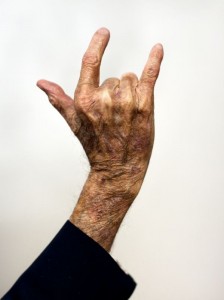
"I love you" - in sign language. Professor Tobias's hand
Pictures by Pep Bonet
Young man with that stone in your hand
March 25th, 2012. Published under South Africa. No Comments.
First thing each morning Simon Williamson from the Daily Maverick steps into my office and reminds me that whilst I was sleeping the world moved on, that wars are being faught, that bombs are exploding, children are being born, and the sun has been rising as I slumbered.
But this week his morning news reports have been particularly disturbing. Although I sit at my desk some 10.000 kilometres from South Africa, my interest in following the events of daily life unravel in SA on Twitter and on the news has bacome to some degree an obsession.
After writing my book Remarkable South Africans, and daily assembling the building blocks of Seed Community (providing interest free higher education loans and mentoring to girls in Johannesburg coming from a challenging socio-economic background) – I feel I have gained a deeper understanding of the country I grew up in.
But what disturbed me most was reading the article “Vigilante Violence: The Smoke that calls” by Mandy de Waal.Of three young men, accused of being thieves, whose fate was placed in the hands of an angry community in Enkanini informal settlement in Khayelitsha, South Africa’s fastest growing township.
They stoned them, tortured them, had tyres put around them and set them alight – whilst the community looked on feeling that justice had been done. The people of Enkanini are deeply frustrated, they feel that promises made to them by the government have not been met. They lack decent housing, electricity, employment and security. They feel that the justice sysyem has failed them, and so increasingly rely on street justice to deal with trouble in the community.
Moving on from Enkanini to the township of Ratanda south of Johannesburg, where violent protests have been taking place the last 4 days. The residents are dissatisfied with the electricity supply, and are protesting that the bills are excessive.
Again violent mobs have rampaged through the street, burning down homes, destroying property and threatening the lives of innocent individuals. In their rage they seem to have lost touch with the purpose of their anger and use the protests to vent all their rage, their dissapointment and their frustration. Reporter Greg Nicolson writes how he had to run for his life, as the mob disregarded his purpose, not understanding that as a journalist his presence acts as a loud speaker to their message.
I feel heavy hearted, because I see this great nation going into self-destruct.
I am in no position to judge – I was born on the privileged side of history.
Nor can I hope to fully grasp the complexity of the socio-economic challenges that form multiple layers in our society, that dictate how we relate to one another.
Although I can see the suffering, I can understand the anger and I can share the struggle –I cannot justify the violence, the aggression, the xenophobia and the abuse against women, which is devouring our souls.
Channels must be made available for communities to vent their anger and frustration, and their voices must be heard and listened to.
But I cannot see that pangas, sticks and stones will create employment, improve service delivery nor bring justice.

Picture from Daily Maverick
Young man with that stone in your hand
I see you
I fear you
I prayed
I would never meet you
Face
to face.
To see your rage
your hatred
of me
…but you do not know me.
Remember how your mother would wash your uniform
and in the dust its brightness
its whiteness
would shine hope in the streets of Khayelitsha.
With pride she sent you to school each day
Knowing that the world would be cruel and hard and dangerous.
She never dreamed that the system would fail you
That you too would become
Cruel
And hard
And dangerous.
Young man with that stone in your hand
Before you smash my windscreen
Burn my house
And rape me
Because you too have beeen raped
Of your hope, your promised land.
May I tell you my story?
Young man
The very stone that you would use to kill me
Could build a bridge
That might just lead you to me
Where face
to face
Perhaps you would see
that just like you,
my mother also washed my white white shirt
with her hopes and prayers.
And in your rage
And in my fear
Perhaps we can be powerful enough together to change this course
This curse
This moment that would leave you with blood stained hands
And leave me bleeding
For a country whose greatest struggle is still to come.
There will always be more mountains to climb.
March 5th, 2012. Published under Nominees. No Comments.
I was standing on top of the world, overlooking mountains upon mountain peaks. All white and brilliant blue in the sunshine. It was one of those moments of calm and brillance which are often rare to capture in the midst of life and toddlers. The silence and upliftment as I watched a flock of birds rise up from below me - “the rush of quiet birds in circled flight”. I felt watched and watched over. I sensed the clarity the peace the energy that comes with distance, energised by the multiple reflection of light in the snow.
I stood long enough to watch a paraglider trek up the slope and prepare his parachute, and with energy and force watched him pull the kite into the wind and run off the edge … and glide and lift into the sky, sailing the thermals amongst the mountains.
And so it is with our lives. We are all trying to find a path that inspires us, challenges us and makes us feel that we are fulfilling our purpose.
During last weeks visit to Austria we stayed with some dear friends in the small town of Bizau, with just over 1000 inhabitants, who have created the most unexpected and impressive lifestyle store I have yet to see in the worlds biggest, thriving cities. The road leading to Bizau is a road to no where. There is no traffic, there are no shoppers passing by, and yet the parking lot of Ediths is packed. The store is full. The coffee is outstanding, the cakes homemade and the decor beautiful. As you walk in you are given a beautiful basket, and you cannot help but begin to fill it. People drive from neighbouring towns and countries to visit Ediths, they arrive for breakfast (delicious Bergkase cheeze, smoked ham and free range eggs with a warm bread basket), followed by a little shopping, another coffee and perhaps a glass a wine after another round of shopping.
Their achievement and creativity in creating Ediths reminds me of the paraglider. There was a great mountain to climb, and then daring to just run and throw yourself into the open expanse of the unknown and allow the powers that be to lift and carry you. They dared to dream…
There will always be more mountains to climb. And as always we are left with a choice - the valleys offer comfort, but the views are always more spectacular from the summit.
“Know Thyself”
January 13th, 2012. Published under Nominees. No Comments.
New Years Eve, we were a group of friends festively gathered and ready to welcome the good fortunes of 2012, the year to come. Before the clock struck midnight, a dear friend Neil Crofts (see www.neilcrofts.com - someone who has changed my life more often than he realises – he coaches on fulfilling your purpose, be it for your business or your life) suggested we draw our intentions for 2012 – because “if we don’t have a plan, the risk is we get sucked into someone else’s and the chances of someone else’s plan being fulfilling for us are slim.”
Neil also reminded us of the message above the door of the Temple of Apollo at Delphi, “Know thyself”.
These words have lingered with me since.
The words have challenged me to understand what I really want for the year ahead, defining what is important and the responsibility that comes with the realisation.
So I thought to share my drawing with you:
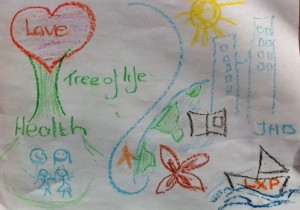
Drawing of 2012
As with most of us, the core of our lives and our fulfillment is family - which we all hope to see grow in health and in love – this was my first drawing.
Thereafter the next thing I drew were the skyscrapers of Johannesburg. At the end of last year I was given access to the dark underbelly of the inner city of Johannesburg. Slum buildings housing thousands of forced migrants (refugees and asylum seekers) and poverty stricken South Africans. I stepped into the shadows – a dark space where individuals forsake their identity, their rights, and their health to survive - and sensed a deep need to make the voices of those who live there be heard and for their issues to become more visible. Together with photographer Pep Bonet www.pepbonet.com , who has already started capturing images of the inner city, this is our pursuit. (You can read about my impressions of entering one of these buildings in my earlier blog, “The Heart of Darkness”.)
I then drew a seed in blossom – Seed Community www.seedcom.org – providing interest free tertiary education loans to girls from disadvantaged communities in South Africa. Mandela spoke of education as “the most powerful weapon which you can use to change the world”. Sharing in the lives, growth and wisdom of the Seed girls has been a privilege and witnessing their determination to seize their lives and be all they can be has been a very humbling experience. This is an ongoing project that I am happy to be a part of and look forward to nurturing its growth.
And then the pursuit of new horizons. LifeXperiences ( www.lifexperiences.com ), our events and destination management company on Mallorca, and Heaven Must Wait ( www.heavenmustwait.com ), tailormade travel to East and Southern Africa. Ventures that continue to offer extraordinary experiences in some of the most beautiful places in the world!
And so as this year begins, I am becoming acutely aware of how important it is to have a meaningful purpose. Time is on the move – watching my girls grow is a daily reminder.
I came across this quote: “Don’t ask what the world needs. Ask what makes you come alive, and go do it. Because what the world needs is people who have come alive.”
Alongside the realisation that I am truely greatful for all that I have in my life, and that we are all in passing - 2012 is a year of being alive.
The Heart of Darkness - Johannesburg
November 24th, 2011. Published under Nominees. No Comments.
Johannesburg, Wednesday 23 November.
As I drove into central downtown Johannesburg, the mist was hanging low over the city. A grey fog had descended heavy over the city’s skyscrapers, the mood seemed gloomy and I started to doubt whether my quest to capture stories of Zimbabwean refugees living in the inner city was really a good idea.
I have been following the stories of foreigners who stream in their thousands into Johannesburg from the surrounding African states, especially from Zimbabwe, in the hope of finding work, money and a better life. However, the reality that awaits them is harsh, cruel and desperate.
But I wanted to see it for myself, I wanted to gain a better understanding of what brings them here, and despite the growing xenophobic sentiment that is a fast spreading disease in our society, why do they choose to stay, do they have any choice and how do foreigners survive the persecution against them.
I was feeling burdened as I passed the Nelson Mandela Bridge, across the railway into what is regarded as one of the world’s most dangerous cities. My first stop was Bishop Paul Verryn, custodian of the Central Methodist Mission, a church that has opened its doors to approximately 3000 refugees and the city’s poor and destitute.
We spoke about the church, its support of those who seek its refuge, and we touched on the philosophical discourse of defining our common humanity. He warned that unless we all embrace the spirit of Ubuntu, arrogance would consume us. He spoke of choice – and that we all have a choice: “you can be dead before you are dead, or you can make a decision to choose life… fear, guilt, humiliation and loneliness will never grant you peace, but you always have a choice.”
“You must go to see the buildings” he said to me, and introduced me to James Onias Nkomo, a Zimbabwean asylum seeker, who was to guide me to visit what have been termed “urban slum buildings”.
James, Clio (Paul Verryn’s assistant) and I walked deep into the inner city. The streets vibrating with people: hawkers selling cheap snacks and cigarettes, young men lingering in small groups on the street corners, children in school uniforms, women chatting, cars and taxi’s hooting – I made sure to stay close to James, my “pass” into this unwritten no-entry zone.
The first building we visited was called “Chambers”. The leader of the building, Richard Zwane, was waiting for us outside. The building was trashed, vandalised and stripped to its bare core, rubbish littered the streets and gutters.
No electricity and no water. No one enters without the leader’s approval, and no one leaves unless his presence was welcomed.
We lingered, we chatted. We spoke about the greatest need of the people – “work, jobs, having money to pay the rent, to buy food”. Richard explained how the building is due to be evicted by 18 December 2011, but that most will find an alternative place to live before then, they don’t want to face any violent clashes with police.
When asked about the police, and if they patrol the area, he said, “we have an understanding, this is my territory, they have theirs”.
“Come lets go inside”. I followed up the stairs, as the residence of the building watched in silence, no one greeted us. Richard opened the first door into the building, and let it slam behind us – darkness descended. Blackness, blacker and deeper than night. Come I heard his voice call, the light of his mobile phone walking into a large expanse of empty space.
The building engulfed us. The darkness pressing hard against my chest, my eyes straining to adjust. The tension crept slowly around us, as Richard called us down dark corridors lined with stripped doors locked with chains and padlocks. Behind each door was someone’s home. Someone’s dark room, lit by a candle.
As we walked deeper and deeper along the corridors tension was joined by silence. A thick silence that suffocates sound, deafens the screams and any call for help would be forever unheard. Then fear shot through me – momentarily - and I was ready to move on, get out, see the light.
As we returned to the busy streets, the hustle and bustle of what was previously a threatening space, was in comparison to the inside of that building a welcoming place.
I did not need to visit more buildings, but James was already calling the next “leader”, just one more he said.
Steven Brian was impatiently waiting for us. As an albino his pale skin and green eyes seemed juxtaposed against his African features. His shacking eyes unnerved me, making it difficult to read his thoughts and interpret his actions. We found a quiet place to sit in “his” building. He was generous with his words, his story laden with multiple levels of persecution and struggle.
I thanked him and we left. I needed to move on.
Today was one of the most sobering and emotionally draining experiences of my life.
It is not that I have not seen worse poverty before - it is not that the people are starving - but the darkness was all consuming, the energy was so heavy, the place so hard and stripped of any quality of life. Not even a piece of blue sky to invest a little hope into….
I thanked James for his assistance, and on leaving he asked me, “So how can you help these people. They have shared their lives with you, but what will they get in return?”
A fair question, not easy to answer. I responded that history is made by those who write it, and that the lives of those who live in the “heart of darkness” of Johannesburg, their struggle for survival is unwritten, The South African government would like to press the “delete button”, and wipe out the existence of thousands of desperate refugees and other poor people living in the inner city.
He looked at me with apprehension, and we both knew that my answer would not provide food on his plate nor a safer place for him to sleep at night.
As I sat in my car and left the city the heavens opened and the rain thundered down. The sidewalks erupted as people sprinted for cover. I felt I needed to get out, be cleansed, and allow the rain to re-energise me. I just drove home, back across the railway into a contrasting reality of comfort and priviledge that is difficult to reconcile with what I have seen today.
There is power in story telling, this is the beginning of a story that should be told, and must be heard.
Into the shadows: Johannesburg
November 14th, 2011. Published under Nominees. No Comments.
Each day, thousands of Zimbabweans attempt to flee Zimbabwe across the border to South Africa. However, persecution awaits them: they are met with hatred by South Africans, shunned by the police, many have been stripped of their rights, and the abuses they have suffered are most often unseen as the government turns a blind eye to their existence.
Thousands of Zimbabweans face the threat of deportation back to Zimbabwe, so they seek the anonymity of the shadows in the overcrowded squatter camps and the urban slums.
The violence against them is ruthless, random and unpredictable. Entire buildings have turned into urban slums, a breeding ground for violence, crime and disease. In Johannesburg, the slum buildings are controlled by gangs, and are considered unsafe, especially for young women. Most have neither water nor electricity. Those who live in the buildings pay a fee to the gangs, who in return offer protection from the police.
Many Zimbabweans speak of torture and political oppression as individuals forsake their identity, their rights, and their health to survive.
Pictures and film by Pep Bonet, working on a project for MSF in Johannesburg
Book Presentation: South African Embassy, Copenhagen
October 13th, 2011. Published under Nominees. No Comments.
5 October 2011, South African Embassy in Copenhagen
I had the privilege of presenting my book Remarkable South Africans, at the South African Embassy, hosted in the official residence of Ambassador H.E. Ms Samkelisiwe Mhlanga.
An intimate turnout of approx 40 people, followed by tea and scones.
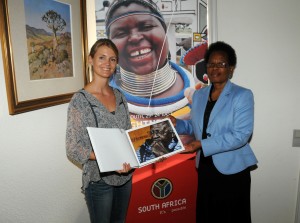
Line Hadsbjerg together with Ambassador H.E. Ms Samkelisiwe Mhlanga
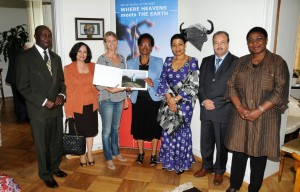
Line Hadsbjerg with Ambassadors representing other African countries
Photo Hasse Ferrold